Hindusthan Educational Institutions, founded in 1992, offer quality education across diverse fields like engineering, science, arts, and management.
Contact Info
- contact : hit.office@hindusthan.net
-
Mon - Sat : 9:00 AM - 06:00 PM
Explore the Deparment of
M.E. VLSI Design
(Accredited by NBA)
(Accredited by NBA)
About Our Department
The Department of M.E. VLSI Design was established in the year 2007 with a sanctioned intake of 18 students. The department is well equipped with qualified, experienced and committed faculty members. Anna University has approved the department with permanent affiliation due to the well-equipped laboratories and good infrastructure as per the curriculum requirements. M.E. VLSI Design department have been granted accreditation by National Board of Accreditation (NBA). The department has churned out several University Rank Holders so far.
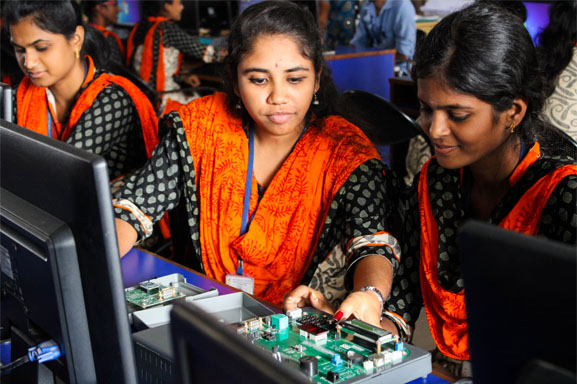
The Department has state-of-the-art laboratory facilities for VLSI Design, including advanced CAD tools and hardware kits for microchip design and testing. The department has signed MoUs with leading electronics industries for industry-institute interaction and student placement.
M.E. VLSI Design Department focuses on cutting-edge research in microelectronics, low power VLSI, and system-on-chip design. The department encourages students to participate in workshops and seminars conducted in collaboration with professional societies like IEEE and IETE. The department sends the students to undergo their Final year projects in collaboration with leading VLSI industries.

Vision and Mission
“To develop value-based professionals with a strong foundation in Electronics and Communication Engineering and innovative technical skills with eminent leadership qualities and ethical conduct.”
MD1:To establish a conducive and inspiring learning environment towards value-based education.
MD2:To educate the students with the state of art technologies to meet the growing challenges of the industry and to guide them towards research in varied fields of Electronics and Communication Engineering.
MD3:To provide a quality system for wholesome learning to achieve progress and prosperity in life along with moral values.
PSOs, PEOs & POs
PEO 1:Graduates will possess innovative ideas to, design, simulate, develop and test software and hardware components to offer solution in modern engineering applications.
PEO 2:Graduates will work effectively in a multi-disciplinary environment and individually, within a global, societal, and environmental context.
PEO 3:Graduates will inculcate in professional ethics and codes of professional practice for succeeding in Professional career.
PSO 1:Enable graduates to design and develop effective systems for engineering and societal applications by advanced technologies in the field of Electronics and Communication engineering.
PSO 2: The graduate will be empowered to take initiative in their profession and pursue lifelong learning to stay at the forefront of advancements in global needs.
At the time of graduation, the students of Electronics and Communication Engineering should have the
PO 1: ENGINEERING KNOWLEDGE: Apply knowledge of mathematics, natural science, computing, engineering fundamentals and an engineering specialization applicable to compute science and engineering discipline to develop to the solution of complex engineering problems.
PO 2: PROBLEM ANALYSIS: Identify, formulate, review research literature and analyze complex engineering problems reaching substantiated conclusions with consideration for sustainable development.
PO 3: DESIGN /DEVELOPMENT OF SOLUTIONS: Design creative solutions for complex engineering problems and design/develop systems/components/processes to meet identified needs with consideration for the public health and safety, whole-life cost, net zero carbon, culture, society and environment as required.
PO 4: CONDUCT INVESTIGATION OF COMPLEX PROBLEMS: Conduct investigations of complex engineering problems using research-based knowledge including design of experiments, modelling, analysis & interpretation of data to provide valid conclusions.
PO 5: ENGINEERING TOOL USAGE: Create, select and apply appropriate techniques, resources and modern engineering & IT tools, including prediction and modelling recognizing their limitations to solve complex engineering problems.
PO 6: THE ENGINEER AND THE WORLD: Analyze and evaluate societal and environmental aspects while solving complex engineering problems for its impact on sustainability with reference to economy, health, safety, legal framework, culture and environment.
PO 7: ETHICS: Apply ethical principles and commit to professional ethics, human values, diversity and inclusion; adhere to national & international laws.
PO 8: INDIVIDUAL AND COLLABORATIVE TEAM WORK: Function effectively as an individual, and as a member or leader in diverse/multi-disciplinary teams.
PO 9: COMMUNICATION: Communicate effectively and inclusively within the engineering community and society at large, such as being able to comprehend and write effective reports and design documentation, make effective presentations considering cultural, language, and learning differences.
PO 10: PROJECT MANAGEMENT AND FINANCE: Apply knowledge and understanding of engineering management principles and economic decision-making and apply these to one’s own work, as a member and leader in a team, and to manage projects and in multidisciplinary environments.
PO 11: LIFE LONG LEARNING: Recognize the need for, and have the preparation and ability for i) independent and life-long learning ii) adaptability to new and emerging technologies and iii) critical thinking in the broadest context of technological change.
Meet Our Esteemed Faculty
Loading...
Laboratories
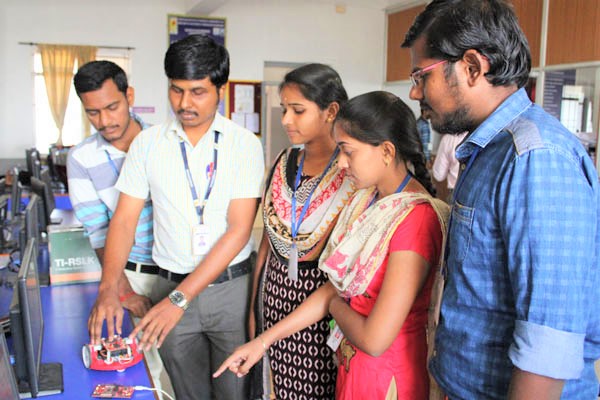
Texas Instruments Powered - Embedded Systems Laboratory
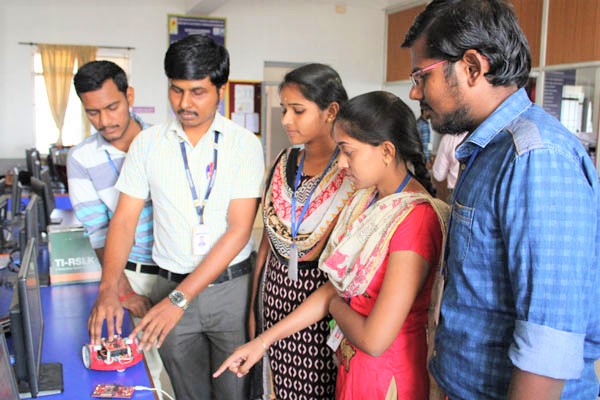
This Centre of Excellence provides training on embedded systems so that students can meet the industry standards and can make projects based on the embedded systems. This COE has latest microcontroller units of Texas Instruments on which students can perform hands on experience. The main objective of setting up this Coe is to provide a bridge between industry and academic needs. Also the purpose of setting up this COE is students will be able to design, describe, validate and optimize embedded electronic systems in different industrial application areas.
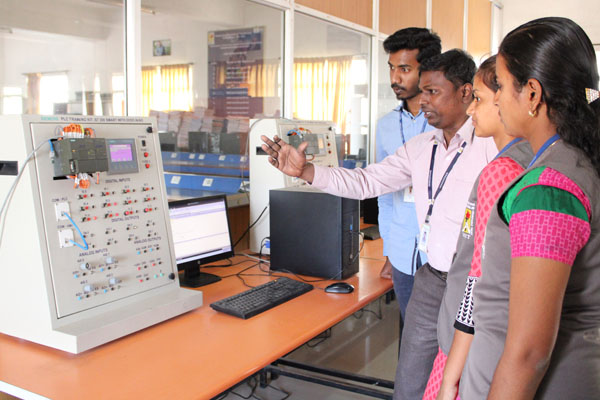
Siemens Powered Genn Automation - PLC & SCADA Laboratory
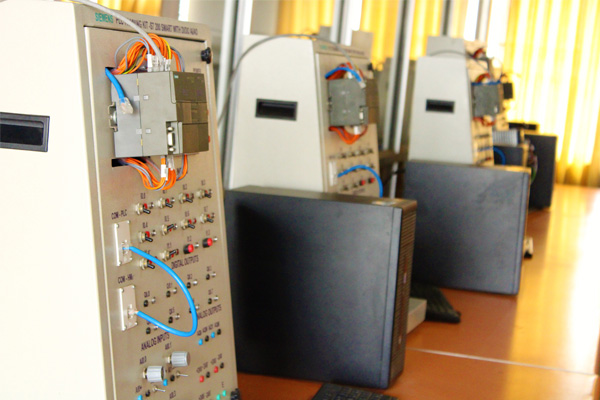
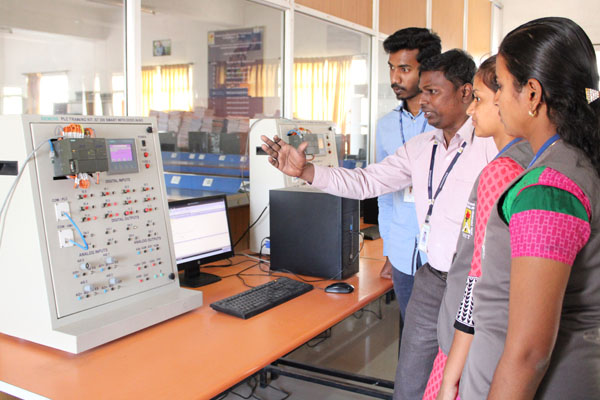
The PLC laboratory is setup to complement the topics studied in the automation theory course. The lab is equipped with PLC automation trainer kits and modules to enable the study of components of automation system. The students perform experiments to study the components of PLC, programming PLC, interconnection of PLC with computer, SCADA programming and fault detection in automation system. A PLC (i.e. Programmable Logic Controller) is a device that was invented to replace the necessary sequential relay circuits for machine control. The PLC works by looking at its inputs and depending upon their state, turning on/off its outputs. PLCs are used in many "real world" applications. SCADA systems are now used in the controls of ancillary systems such as cooling, ventilation, power distribution, etc. and have made substantial progress over the recent years in terms of functionality, scalability, performance as well as openness, such that they are an alternative to in-house development even for very demanding and complex control systems.
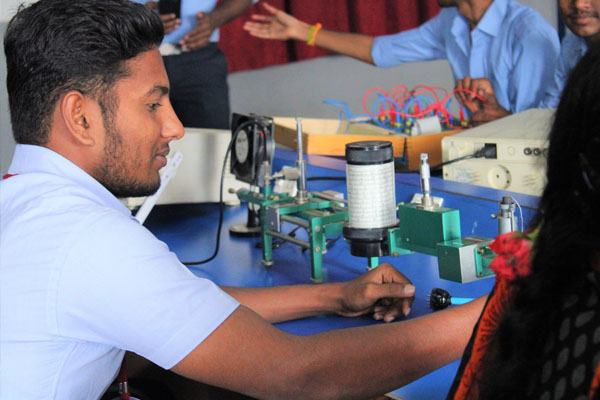
Optical and Microwave Laboratory
Demonstrating the basic principles in the area of strength and mechanics of materials and structural analysis to the undergraduate students through a series of experiments is the objective of the strength of materials lab. Measuring the properties of the materials such as impact strength, tensile strength, compressive strength, hardness, ductility are conducted in the lab.Major Equipments Strength of Materials Lab:- Universal testing machine, Torsion testing machine, Impact testing machine, Brinell hardness testing machine, Rockwell hardness testing machine, etc.
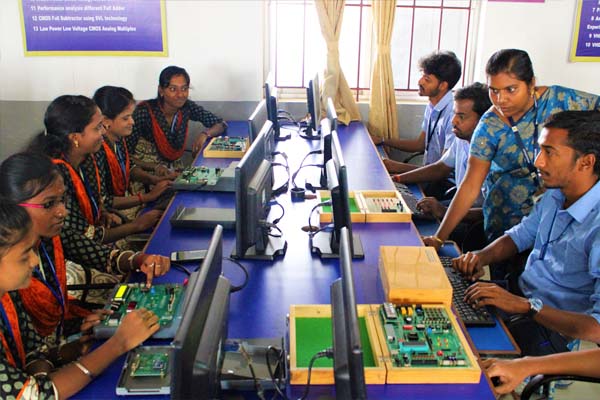
DSP/VLSI Laboratory
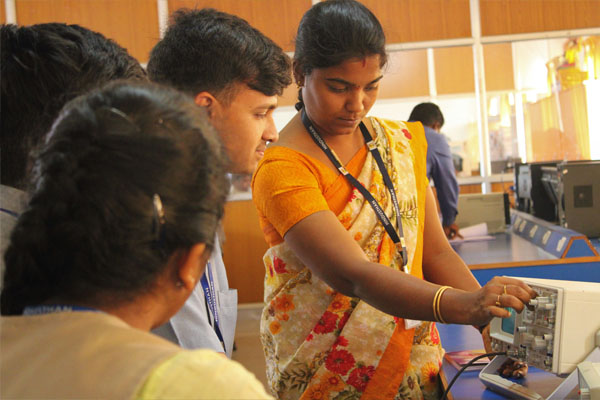
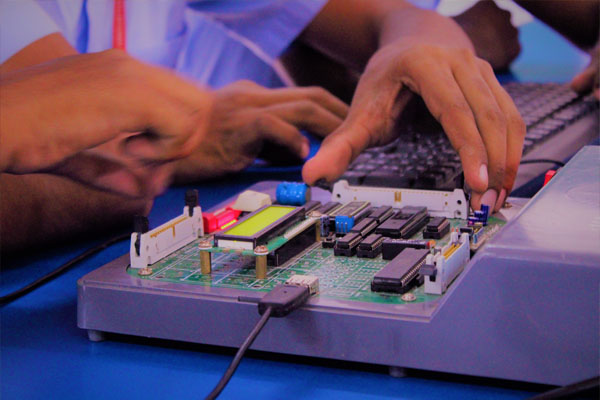
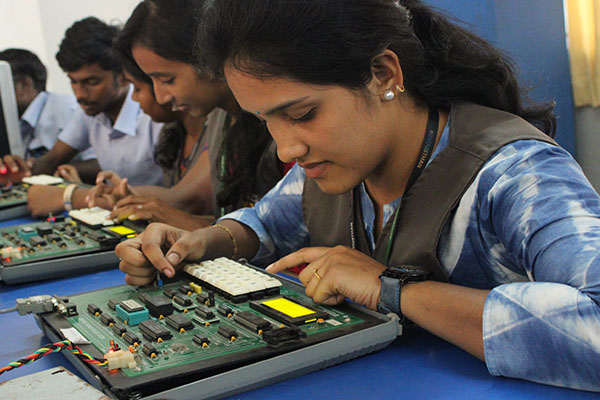
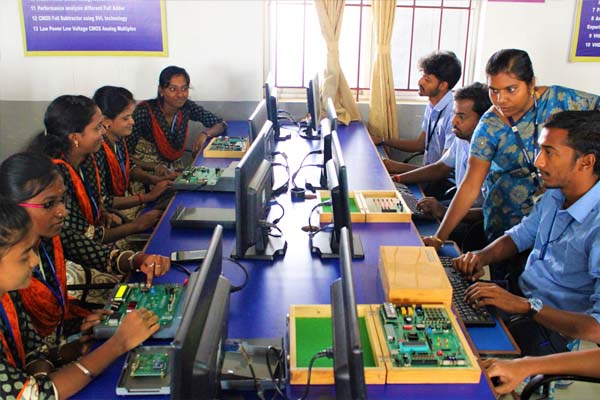
The DSP/ VLSI laboratory is well equipped with the most up-to-date industry standard DSP and VLSI EDA tools and hardware resources like MATLAB software with various Tool boxes and Simulink, Xilinx 12.1,ModelSim Tanner EDA tool, CADENCE Tool, QCA Designer Tool, TMS 320C5416,Spartan3 FPGA, Logic Analyzer, DSO,ADC/DAC Kit and CPLD. The laboratory provides a platform for the students and researchers to study and explore both hardware and software techniques in the field of Digital Signal Processing and VLSI. Undergraduate and Postgraduate students to implement Real-time project work in areas like Low Power VLSI, Signal Processing and Image Processing.
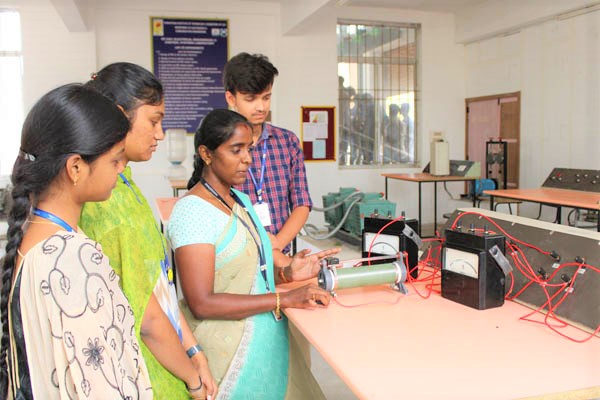
Electrical Laboratory
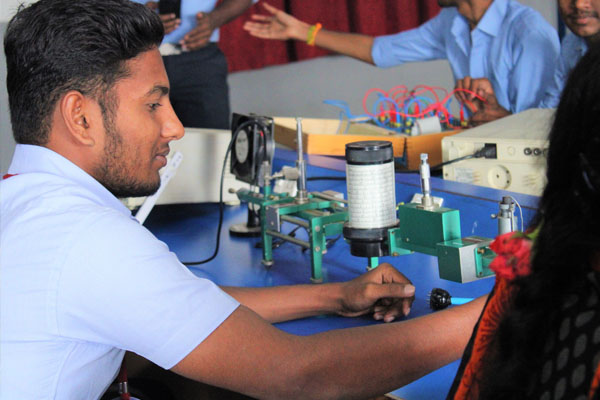
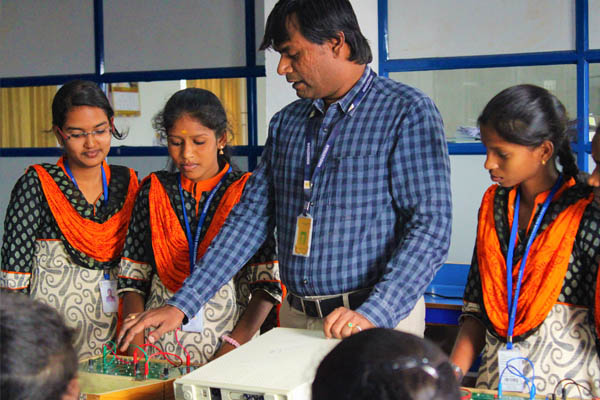
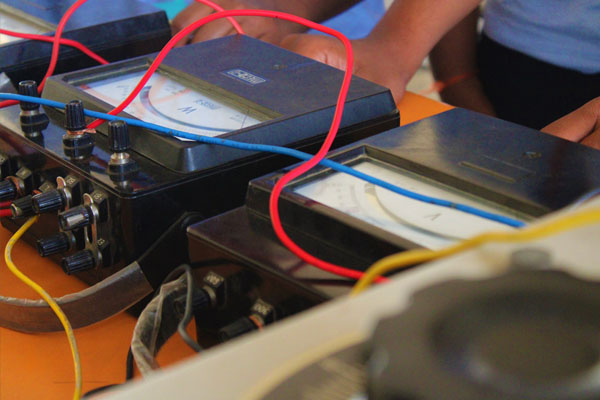
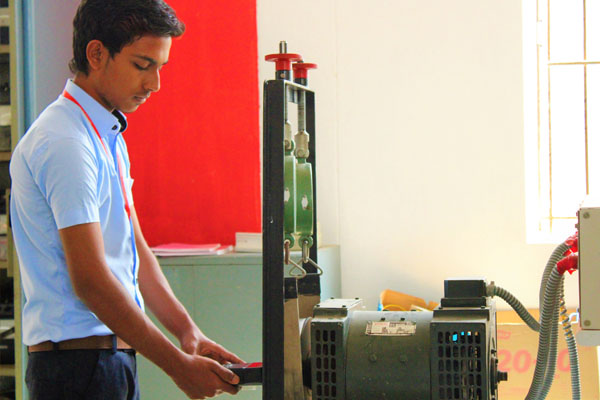
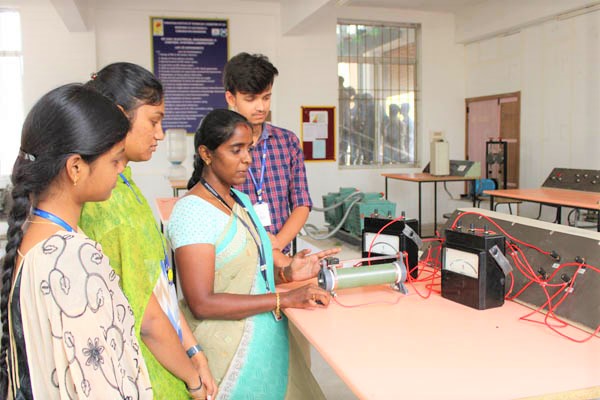
The Electrical Engineering Laboratory has efficient learning facility designed to provide electrical engineering students with hands-on experience in the basic machineries employed in industry. The lively learning environment that can house 45 students and teaching staff. Each work station is equipped with the latest electrical engineering technologies .Additionally, the laboratory also has a learning and breakout zone to encourage students and staff to work collaboratively. Developing state-of-the-art machines and monitoring and diagnostics technologies to enable faster, greener ways to power build and move the world. This is the lab where experiments like load test on various machines, speed control tests, open circuit tests, short circuit tests are carried out. And also wide varieties of practical experiments are performed here with grouping of different rotating machines. The laboratory is also used for exploration activities in machines and to carry out project works on energy conversion.
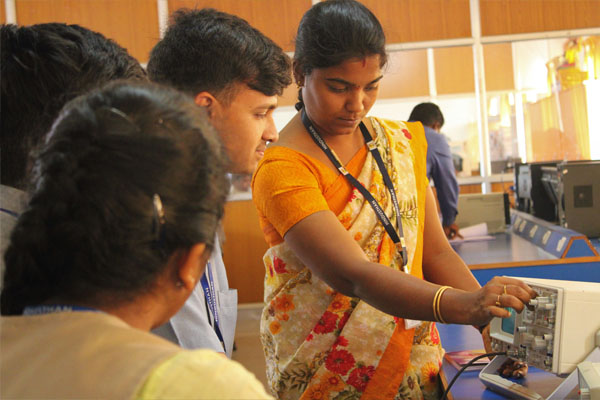
Electronics Laboratory
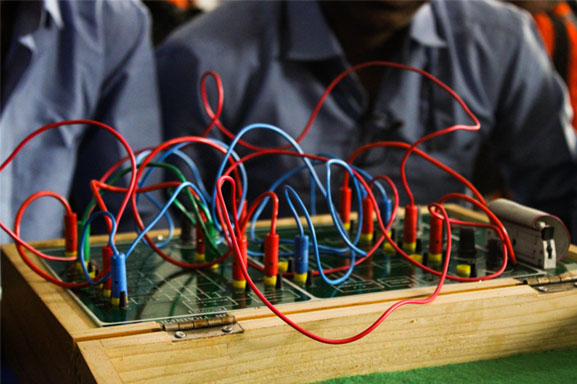
All basic electronic devices and their characteristics, applications can be studied. Using these devices, the small electronic circuits and mini projects can be constructed and checked. In order to introduce the students with basic components of electronics this lab is furnished with advanced CROs, function generators and digital multi meters. Students can perform practical on P-N junction diode, Zener Diode, rectifiers and filters, transistor biasing and their characteristics in different modes, RC coupled amplifiers and FETs.
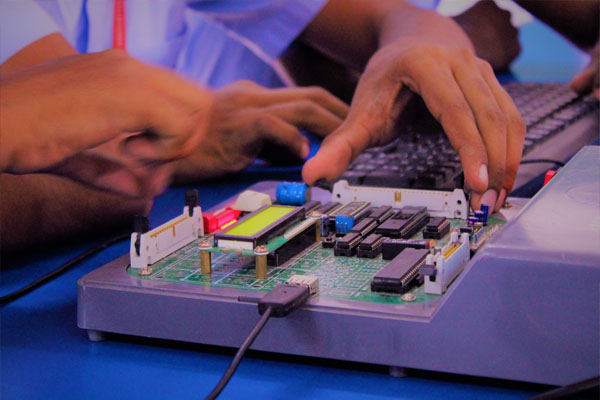
Microprocessor Laboratory
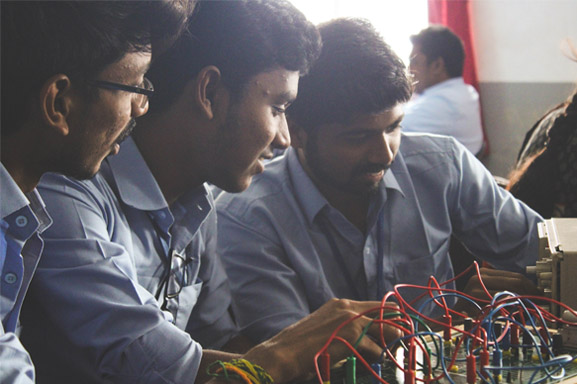
The Microprocessor Laboratory aims in inculcating the knowledge of programming skills by executing various programs like arithmetic operations, code conversions, searching and sorting algorithms studied in the Microprocessor and Microcontroller.Students from other branch of engineering and sciences also come to this lab and develop their skills in the field of microprocessor and its applications.The features and facilities available in this lab will help the students do their projects and enhance their knowledge about the latest trends and technologies. The students have in depth knowledge in writing and executing 8086 8085 and 8051 Assembly Language programs. Microprocessor laboratory is equipped with microprocessor kits and interfacing devices.The students achieve encoding skills in Assembly Language and Interfacing with various devices.
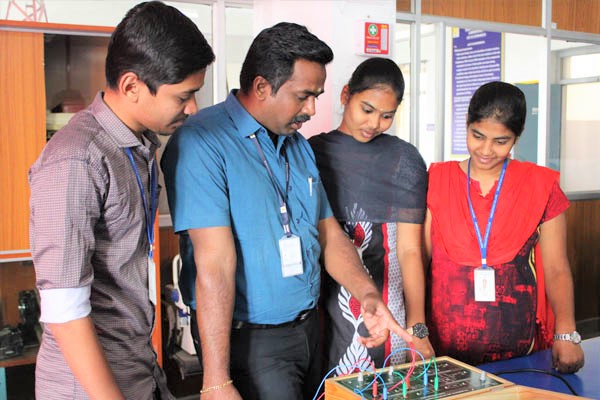
Communication Systems Laboratory
The Communication Systems Laboratory has been equipped with Digital Function generator, Pulse Code Modulation kit, Pulse Code Modulation kit AM/FM transmitter and receiver kits and many other experimental kits. Communication systems laboratory focuses on training the students in both analog and digital transmission/reception of signal. The students here start in the analog area by constructing the circuits of amplitude modulation, frequency modulation and phase modulation. Communication systems Laboratory is catering to the needs of facilities in communication field by training its students to make valuable contribution. This lab is used by B.E students of different branches like Electronics & Communication, Information Technology.
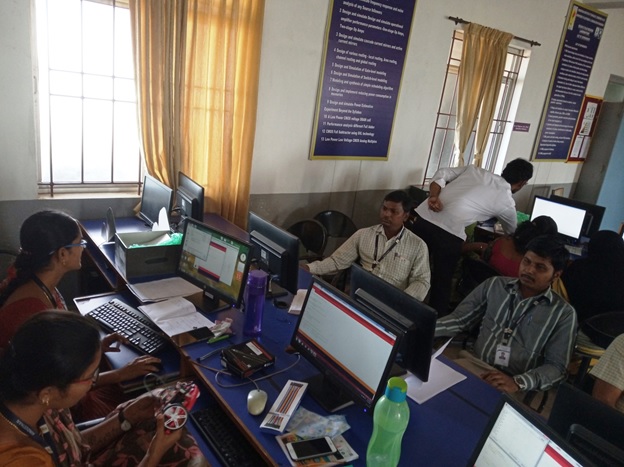
Embedded System Laboratory
The Embedded System Lab was established in 2016 as an academic lab for under Graduate students as per Anna University syllabus and all the experiments are designed, tested and verified according to the experiment list. The Embedded systems lab implemented using Cortex M4 Arm Processors and embedded C programming language covering various aspects related to the subject for better understanding.
Collaboration & MoU



Innovative Teaching Methodologies
Neuro-Fuzzy Filtering and Multiwavelet Transformation
for
EEG Signal for Efficient Removal of Artifacts
An Exhaustive Study on Mobile Localization Approaches
to
Improve Quality of Service in Wireless Sensor
Networks
Comparative Analysis of Performance of Multi Objective
PSO
and NSGA II for the Classification of Diabetic
Retinopathy
in Retinal Images
Certain Investigations on Design and Implementation of
Digital FIR Filter using Low Power and High Speed
Multipliers
Compression Artifact Reduction and Moving Object
Tracking
in the Images and Videos
Certain Investigations on Dual Edge Triggered Sense
Amplifier Flip-Flops for Low Power and High Performance
Applications
A Novel Design of Nano Router with High Speed Crossbar
Scheduler for Digital Systems in QCA Paradigm
A Novel approach for generation of power by Harvesting
microwave from the ambient environment
A Proficient Technique for High Performance Very
Large-Scale Integration System to Amend Clock Gated Dual
Edge Triggered Sense Amplifier Flip-Flop with Less
Dissipation of Power Leakage
Efficient Removal of Artifacts from EEG SIGNAL Using
Enhanced Hybrid Learning Method
Tumor Categorization Model (TCM) Using Soft Computing
Techniques for Providing Efficient Medical Support in
Brain
Tumor Treatments
Simulation and performance analysis of 15Nm FinFET
based
carry skip adder
Intelligent Detection of the PV Faults Based on
Artificial
Neural Network and Type 2 Fuzzy Systems
A study of the physical properties and gas-sensing
performance of TiO2 nanofilms: Automated nebulizer spray
pyrolysis method (ANSP)
Effect of thickness on the physical properties and gas
sensing application: anatase titanium dioxide nanofilms
by
automated nebulizer spray pyrolysis (ANSP))
War field soldier body condition monitoring
system
Classification using fundus image of eye by CNN method
and
self-sufficient glaucoma detection using IOT
Self-destruction of data in cloud using asymmetric key
with key generator
Convolutional networks for motion detection in smart
gadgets
Optimization in design of hybrid electric power
network
using HOMER
Sponsored Research Projects Details
| S.No | Funding Agency with Sanction Order No | Project / Proposal Title | Proposal Scheme | Year of Sanction | Amount / Status |
|---|---|---|---|---|---|
| 1. | Department of Science & Technology (DST-NRDMS DIVISION) Ref No: NRDMS/SC/ST/29/016 |
Controlling the Growth of Infectious Diseases among Scheduled Caste/Tribal Women and Girls by Developing Hygienic Cost-Effective Sanitary Napkins and making them Entrepreneurs | Natural Resources and Data management System (NRDMS) | 2016 | Rs:6,08,000 Completed |
| 2. | Institution of Electronics Engineers India (IEI) Ref No: R.4/2/UG/17-18/UG2018003 |
An intelligent Helmet for miners with air quality and destructive event detection using Zigbee | Student Project proposal Scheme (SPS) | 2017 | Rs:20,000 Completed |
| 3. | Tamil Nadu State Council for Science and Technology (TNSCST) Ref No:TNSCST/SPS/AR/2017-18/199 |
Automatic Cameras based clothing pattern recognition for visually impaired people | Student Project proposal Scheme (SPS) | 2018 | Rs:10,000 Completed |
| 4. | Department of Science & Technology (DST-SEED DIVISION) Ref No:SEED/WS/2018/13 |
Endorsing Employment Confidence of women through Appropriate Coir Cluster Merchandises Training Development for their life Uplifting in Rural Environment | S&T for Women (WS) | 2018 | Rs:13,78,318 Completed |
| 5. | All India Council for Technical Education
(AICTE) F.No:9-76/RIFD/MOD/Policy-1/2018-19 |
MODROB (Modernization & Removal of Obsolescence) for Developing Advanced VLSI Laboratory | MODROB | 2020 | Rs:11,00,000 Completed |
| 6. | Tamil Nadu State Council for Science and Technology (TNSCST) Ref No: TNSCST/SPS/AR/2019-20/106 |
Drunken Drive Accidents Avoiding System Using Neuronal Activity of the Brain | Student Project proposal Scheme (SPS) | 2020 | Rs:7,500 Completed |
| 7. | Department of Science & Technology (DST-NCSTC DIVISION) Ref No: CO/B/FP/G88/2021(C) |
Development of Innovation, Science and Technology Generation Skills for Rural School Children | Research Proposal (Children Centric Outreach Programme) | 2021 | Rs:11,55,232 Completed |
| 8. | Hindusthan Educational and Charitable
Trust (HECT/RSM/P01/HITECH/2020-21/07) |
Design a Fully Textile Fractal Monopole Wearable Antenna for Medical Imaging Applications | Research Seed Money | 2020 | Rs.2,00,000 Completed |
| 9. | Hindusthan Educational and Charitable
Trust (HECT/RSM/P01/HITECH/2020-21/08) |
Development of Cryptographic Techniques for Images using Discrete Rajan Transform | Research Seed Money | 2020 | Rs.1,20,000 Completed |
| 10. | Hindusthan Educational and Charitable
Trust (HECT/RSM/P02/HITECH/2021-22/05) |
To design a Self Defense Smart Device for Women’s Safety from Abusing and Harassment | Research Seed Money | 2020 | Rs.1,20,000 Completed |
| 11. | Hindusthan Educational and Charitable
Trust (HECT/RSM/P02/HITECH/2021-22/06) |
Designing of IOT based Health Monitoring and Fall Detection System for Old People | Research Seed Money | 2020 | Rs.1,20,000 Completed |
| 12. | Hindusthan Educational and Charitable
Trust (HECT/RSM/P02/HITECH/2021-22/07) |
FPGA Implementation of Medical Image Fusion for Lung Disease Detection | Research Seed Money | 2020 | Rs.1,20,000 Completed |
| 13. | Tamil Nadu State Council for Science and Technology (TNSCST) Ref No: TNSCST/SPS/AR/2021-22/0559 on 01.03.22 |
A novel approach to communicate and to detect emotion of differently-abled persons using sensor devices and Electroencephalogram Signals | Student Project proposal Scheme (SPS) | 2022 | Rs.7,500 Completed |
| 14. | Tamil Nadu State Council for Science and Technology (TNSCST) Ref No: TNSCST/SPS/BS/2022-23 on 03.03.23 |
Development of Autonomous Quadcopter for Farmland Surveillance Using GPS navigation algorithm for the benefit of farmers. | Student Project proposal Scheme (SPS) | 2023 | Rs.7,500 On going |
| 15. | Institution of Electronics Engineers India(IEI) Ref No: R.4/2/UG/2022-23/UG2023022 on 23.03.2023 |
Design and Development of Solar Powered Multipurpose Drone for Praying pesticides, Fertilizers and Disinfectants for Precision Agriculture’. | Student Project proposal Scheme (SPS) | 2023 | Rs.22,000 On going |
Sponsored Seminar/Symposium & Patent Details
Gallery